
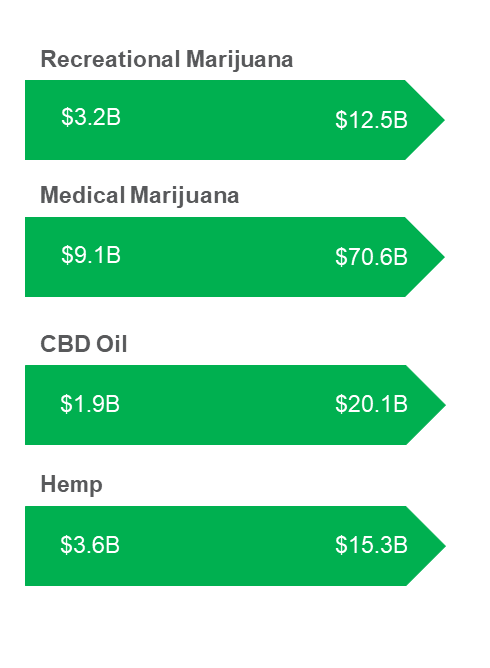
There are 4 components of the cannabis industry; Recreational Marijuana, Medical Marijuana, CBD Oil and Hemp.
Recreational Marijuana is legal in 11 U.S. states, recreational marijuana refers to cannabis used to intentionally experience its intoxicating and mind-altering effects. U.S. recreational sales are expected to grow at an incredible 18.4% CAGR, from $3.2 billion to $12.5 billion in 2025.
Medical marijuana refers to the use of cannabis as a physician-recommended therapy for treating certain health conditions and symptoms. It is legal in 35 U.S. states. Sales of U.S. medical marijuana are expected to grow at an 26.7% CAGR, from $9.1 billion in 2020 to an estimated $70.6 billion in 2028.
CBD is a non-intoxicating nutritional supplement made from hemp that is used to promote wellness. It is legal under U.S. Federal Law. Individual states may enact their own laws around hemp-derived CBD. The nation’s CBD market is predicted to have a compound annual growth rate of 49% by 2024, surging from $1.9 billion million to $20 billion with a CAGR 21.2%
Hemp is a versatile industrial crop with more than 25,000 product applications. Over 40 states have established commercial or pilot hemp cultivation programs made legal under the Farm Bill. U.S. hemp-based products are expected to grow from $3.6 billion in 2020 to a $15.3 billion by 2027, with CAGR of 16.2%.
The U.S. market for minor cannabinoids is anticipated to be valued at $26.2 B by 2028, due to the rising use of cannabinoids and increasing awareness regarding their health benefits.
The minor cannabinoid Tetrahydrocannabivarin (THCV) held the largest revenue share in 2020, owing to the adoption of THCV in various medical applications such as epilepsy, arthritis, metabolic disorders, neurological disorders, and pain management.
In 2020, CBG had the highest growth of the minor cannabinoids, owing to the increase to clinical trails and adoption of minor cannabinoids for health conditions. Some of the conditions included in other segments are metabolic disorders, arthritis, dermatological conditions, diabetes, cardiovascular diseases, glaucoma, cancer and numerous other health conditions. We currently have an 18% CBG strain which is higher than the current 2% CBG average.
The Total Addressable Market, or TAM, is one of the most critical factors for any industry. Due to marijuana being federally illegal, marijuana companies cannot ship marijuana across state lines. Thus, in the marijuana industry, the TAM is limited to the company’s state. Florida’s marijuana industry happens to have one of the strongest TAMs in the world.
As of December of 2020, Florida has more than 450,000 qualified patients, consistently increasing by almost 3,000 patients per week. Patient growth has made Florida the largest medical-marijuana market in the country by sales. More importantly, Florida has a population of more than 20 million and a tourist population of almost 150 million, which means it is positioned to be one of the largest marijuana markets in the world once adult-use regulations go into effect. Currently, there are almost 300 retail locations, with an expected 500 locations by the end of 2022, which will make Florida one of the most dominant markets in the world.
There are 4 components of the cannabis industry; Recreational Marijuana, Medical Marijuana, CBD Oil and Hemp.
Recreational Marijuana is legal in 11 U.S. states, recreational marijuana refers to cannabis used to intentionally experience its intoxicating and mind-altering effects. U.S. recreational sales are expected to grow at an incredible 18.4% CAGR, from $3.2 billion to $12.5 billion in 2025.
Medical marijuana refers to the use of cannabis as a physician-recommended therapy for treating certain health conditions and symptoms. It is legal in 35 U.S. states. Sales of U.S. medical marijuana are expected to grow at an 26.7% CAGR, from $9.1 billion in 2020 to an estimated $70.6 billion in 2028.
CBD is a non-intoxicating nutritional supplement made from hemp that is used to promote wellness. It is legal under U.S. Federal Law. Individual states may enact their own laws around hemp-derived CBD. The nation’s CBD market is predicted to have a compound annual growth rate of 49% by 2024, surging from $1.9 billion million to $20 billion with a CAGR 21.2%
Hemp is a versatile industrial crop with more than 25,000 product applications. Over 40 states have established commercial or pilot hemp cultivation programs made legal under the Farm Bill. U.S. hemp-based products are expected to grow from $3.6 billion in 2020 to a $15.3 billion by 2027, with CAGR of 16.2%.
The U.S. market for minor cannabinoids is anticipated to be valued at $26.2 B by 2028, due to the rising use of cannabinoids and increasing awareness regarding their health benefits.
The minor cannabinoid Tetrahydrocannabivarin (THCV) held the largest revenue share in 2020, owing to the adoption of THCV in various medical applications such as epilepsy, arthritis, metabolic disorders, neurological disorders, and pain management.
In 2020, CBG had the highest growth of the minor cannabinoids, owing to the increase to clinical trails and adoption of minor cannabinoids for health conditions. Some of the conditions included in other segments are metabolic disorders, arthritis, dermatological conditions, diabetes, cardiovascular diseases, glaucoma, cancer and numerous other health conditions. We currently have an 18% CBG strain which is higher than the current 2% CBG average.
The Total Addressable Market, or TAM, is one of the most critical factors for any industry. Due to marijuana being federally illegal, marijuana companies cannot ship marijuana across state lines. Thus, in the marijuana industry, the TAM is limited to the company’s state. Florida’s marijuana industry happens to have one of the strongest TAMs in the world.
As of December of 2020, Florida has more than 450,000 qualified patients, consistently increasing by almost 3,000 patients per week. Patient growth has made Florida the largest medical-marijuana market in the country by sales. More importantly, Florida has a population of more than 20 million and a tourist population of almost 150 million, which means it is positioned to be one of the largest marijuana markets in the world once adult-use regulations go into effect. Currently, there are almost 300 retail locations, with an expected 500 locations by the end of 2022, which will make Florida one of the most dominant markets in the world.
Sign up our newsletter to get update information, promotion and insight